Insights from HCSA & HFMA events
Q&A with Chris Hague
The HCSA & HFMA Annual Conferences are the must-attend events for professionals in the healthcare supply chain and finance. Digital Modus had the pleasure of attending and showcasing an exciting new AI procurement and cost savings platform use case to the sector. We sat down with Chris Hague, our strategy director to gain his insights and break down the key takeaways from the two events…
Q: Chris, you attended both the HFMA and HCSA conferences recently – tell us a bit about them and why they were such important events.
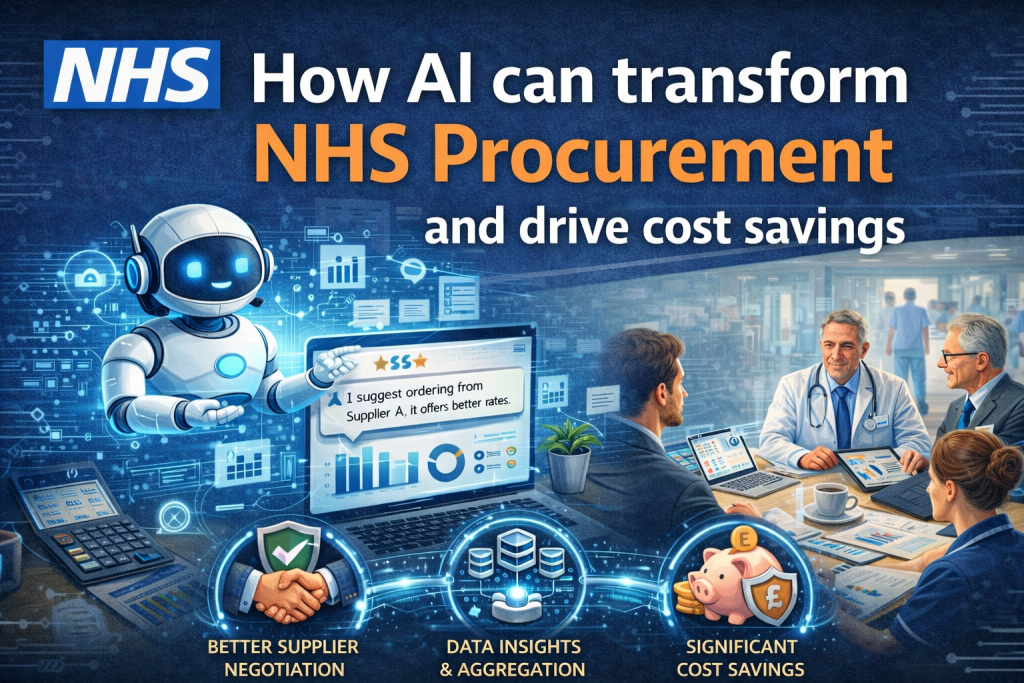
A: The HCSA event is the annual gathering for procurement leaders across the NHS and the HFMA’s the same for Financial leaders. This year was our first time attending, and it was a great success. We went to showcase our cost savings module from the Supplier Relationship Management (SRM) suite – particularly our work on data aggregation and cost-saving identification pilot with an NHS Procurement Collaborative.
Q: How did that collaboration resonate with the audience?
A: Exceptionally well. Edd James MBE procurement director for Humber & N.Yorks presented our Agentic capabilities at both events to packed rooms, demonstrating real examples of how we can alleviate admin burdens and streamline requisition processes. The energy in the room was incredible. People were genuinely excited to see practical applications that could free up teams for more strategic work.
Q: The NHS procurement landscape is a very regulated environment. How does SRM fit into that ecosystem?
A: The ecosystem is unique. Our focus is on non-clinical inefficiencies. What really struck a chord with the attendees was that we can leverage both structured and unstructured data to deliver a more agile, AI-driven feature set – one that feels familiar but offers a far richer experience. That familiarity combined with innovation is a winning combination.
Q: What broader trends did you pick up from NHS procurement leaders?
A: Naturally there’s a real push for collaboration across Trusts and Care Boards. Many are only just starting that journey, but there’s strong momentum. Everyone recognises the need to drive efficiencies and reallocate funds to frontline services. The timing for our platform is ideal as it helps organisations collaborate effectively and deliver measurable savings when it’s needed most.
Q: What spiked interest from NHS financial leaders?
A: Our approach is different, we analyse a Trust’s data to find savings from the bottom up. Financial leaders are under enormous pressure to find savings, Trusts have a long tail of suppliers and struggle to identify daily product pricing fluctuations so by standardising and visualising catalogue data in real time, financial leaders are able to identify savings across their entire supplier portfolio. Data then becomes an asset and guides future spend and savings strategies.
Our capabilities across central government were also of significant interest, financial leaders face similar challenges with siloed platforms and a lack of interoperability. Our vast experience in delivering complex data aggregation projects within highly regulated central government organisations with solutions such as the digitisation of correspondence ,onboarding & compliance for applicant tracking systems and both grant and stakeholder management really opened up conversations as to what is possible.
There is a shift in mindset happening to engage with smaller more agile technology suppliers that can add real tangible value quickly.
Q: What are the main challenges teams face when adopting AI?
A: One barrier is the unknown. Many procurement professionals are understandably anxious about what AI and automation might mean for their roles. Building trust and demystifying the technology are crucial steps needed to ease that concern and ensure long-term adoption for successful outcomes.
The positive is that there is a huge appetite for change. NHS organisations clearly recognise the potential of AI and are now engaging in test pilots. AI adoption requires continual evolution – a multi-year journey that relies on support, guidance, and refinement of the tools.
Q: How will AI impact procurement in the NHS over the next year or so?
A: AI will deliver its most immediate value in contract management and supplier management. Today, procurement teams miss up to 90% of contract renewals simply due to lack of tracking and time. AI can fix this by providing timely prompts for renewals, offering insights into supplier performance and ensuring teams enter renegotiations better informed. CFOs are under increasing pressure to deliver savings that protect frontline services so by utilising AI tools in this way it provides the ability to extract meaningful insights from the data and will support stronger business continuity planning to improve efficiencies across the board.
Q: What will be the biggest win for AI in the NHS?
A: There is a powerful link between cost savings and social responsibility. Every £1 million saved directly in the NHS translates to 500 people receiving 24-hour critical care in an ICU. The commercial benefits matter, but the real impact is enabling public funds to be redirected toward better patient care and essential services.
We are mission driven to deliver tangible, data-backed savings through collaboration to improve outcomes for patients. This is what we are passionate about helping the sector to achieve, if you would like to discuss in more detail then please contact Chris – chris.hague@digitalmodus.com